
Stormwater attenuation is a surface water drainage technique used to control the rate at which rainwater runoff is discharged from a development site into the public drainage network or a local watercourse.
Rather than allowing rainwater to flow off a site immediately during a storm event, an attenuation system temporarily holds the excess runoff in a storage structure and releases it at a slower, pre-agreed rate — protecting downstream drains, rivers, and properties from flooding.
In Ireland, stormwater attenuation is a standard requirement for most new residential, commercial, and infrastructure developments. For civil engineers, drainage designers, contractors, and planning authorities, understanding how attenuation works — and what the Irish regulatory framework requires — is essential to delivering a compliant, functional drainage scheme.
What is stormwater?
In Irish drainage terminology, stormwater (also referred to as surface water) is rainwater that runs off roofs, roads, car parks, footpaths, and other impermeable surfaces.
Unlike wastewater — which contains sewage and is treated before discharge — stormwater is generally uncontaminated, but may contain pollutants such as silt, hydrocarbons, and debris depending on the surface it runs off. It is managed separately through a surface water drainage network.
Under Irish Water's Code of Practice, foul water and surface water must be kept entirely separate. Stormwater is the responsibility of the relevant Local Authority or Roads Authority; Irish Water does not accept surface water into its wastewater network.
Why does stormwater attenuation matter in Ireland?
In a natural, undeveloped landscape — farmland, grassland, or woodland — rainfall is absorbed gradually by the soil, taken up by vegetation, or released slowly into nearby streams. This natural process keeps peak flow rates in watercourses relatively low, even after heavy rainfall.
Development changes this completely. Roofs, roads, and hardstanding areas prevent water from soaking into the ground, causing it to run off rapidly and in large volumes. The result is a sharp increase in flow entering the drainage system during and immediately after a storm — far exceeding what nature, or existing infrastructure, can manage.
Without attenuation, the rapid runoff generated by impermeable surfaces overwhelms drainage networks and watercourses, causing localised flooding, sewer surcharging, and erosion downstream. In Ireland, this is also a planning issue — Local Authorities and An Bord Pleanála will not grant permission for any development that cannot demonstrate its surface water discharge will not increase flood risk to third parties.
Attenuation solves this by mimicking the pre-development hydrology of the site, releasing runoff at the rate it would naturally have left the land before it was built on.
Understanding stormwater attenuation
The idea behind stormwater attenuation is simple: collect the peak flow during a storm, store it temporarily, and release it slowly at a controlled rate.
Attenuation systems work by directing surface water runoff from roofs, roads, and paved areas into an underground storage structure.
As the storage fills during a rainfall event, a flow control device at the outlet restricts the rate of discharge to a pre-agreed level — typically matching the greenfield runoff rate for that site.
Once rainfall stops, the stored water drains away gradually, leaving the system empty and ready for the next event.
There are two key figures that govern every attenuation design in Ireland are the runoff rate and the required storage volume. The greenfield runoff rate is the rate at which rainfall would have naturally left the site before development, expressed in litres per second (l/s). This is often used as the basis for the maximum permitted discharge rate after development.
The required storage volume is the volume of water that must be held between the peak inflow rate from the developed site and the restricted outflow rate. This is calculated through hydrological modelling using software, typically based on a 1-in-100 year rainfall event with a climate change allowance applied.
Choosing and setting up your stormwater attenuation system
There are several approaches to providing attenuation storage on a development site in Ireland. The right choice depends on the available land, ground conditions, site layout, and project budget.
Attenuation ponds and basins
Attenuation ponds are open, above-ground storage features that collect and hold surface water runoff. Wet ponds maintain a permanent body of water between storm events; dry detention basins remain empty and only fill during rainfall.
Both can provide large storage volumes and, when well-designed, can offer amenity and biodiversity benefits. However, they require significant land area — often not available on urban or suburban sites — and carry ongoing maintenance obligations.
Geocellular attenuation crates
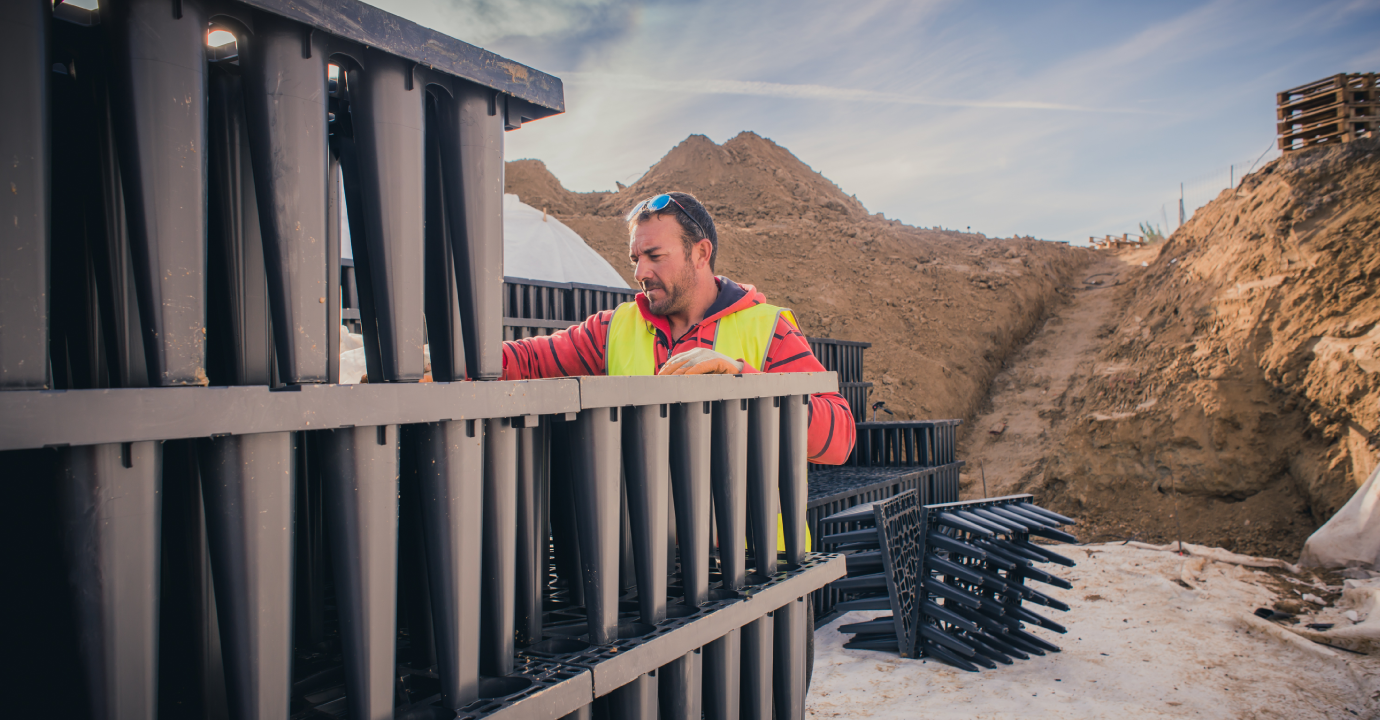
These crates are modular interlocking polypropylene crate systems installed underground, typically beneath car parks, access roads, or landscaped areas. Geocellular crates achieve void ratios of up to 95%-96% meaning they store a very high storage volume of water relative to their physical footprint which makes them the preferred choice where land is at a premium.
Underground tanks, tunnels, and oversized pipes
Precast concrete tanks, tunnels, or large diameter plastics pipes are also used as below-ground solutions. Typically, they are more expensive per cubic metre of storage than geocellular crates when you compare the extra labour and materials required.
Preventative measures
Green roofs, permeable paving, and rainwater harvesting tanks do not replace the need for attenuation tanks but can reduce the volume of runoff that needs to be attenuated, potentially reducing the required storage volume.
Typically, local authorities increasingly expect source control to be considered before underground attenuation tanks are designed.
Controlling the flow rate
Getting the design right from the outset is critical. The process begins by identifying all impermeable surfaces that will generate runoff — and establishing the pre-development greenfield runoff rate, which becomes the maximum permitted discharge rate after construction.
In Ireland, systems are designed for the 1-in-100-year storm event with a climate change allowance applied to peak rainfall intensity, in line with OPW guidance.
Hydrological modelling then determines the storage volume needed to hold the difference between peak inflow and the restricted outflow for the duration of that design storm.
A flow control device — typically a vortex flow control, orifice plate, or throttle pipe — restricts discharge to the agreed rate, and the completed design must be submitted to and agreed with the Local Authority drainage engineer before works commence.
Attenuation through Irelands planning and regulatory system
Stormwater attenuation in Ireland is not optional — it is a regulatory requirement underpinned by a hierarchy of legislation, guidelines, and local policy.
At the primary level, the Planning and Development Act 2000 requires planning authorities to treat surface water drainage as a material consideration, while the Water Services Act 2007 underpins the mandatory separation of foul and surface water systems.
S.I. No. 122 of 2010 transposed the EU Floods Directive into Irish law, establishing the OPW as the lead agency for flood risk management and giving legal weight to the National CFRAM flood mapping programme.
The key operational document is the Planning System and Flood Risk Management Guidelines (DEHLG/OPW, 2009), issued under Section 28 of the Planning Act, which means both Local Authorities and An Bord Pleanála are legally required to have regard to it.
In practice, most drainage designs are benchmarked against the Greater Dublin Strategic Drainage Study (GDSDS), which — despite its regional origin — is referenced by Local Authorities nationwide as the standard for SuDS and attenuation design.
Building Regulations Technical Guidance Document H sets minimum standards at the individual building level, and Irish Water's Code of Practice confirms that surface water management is entirely a matter for the developer and the relevant Local Authority.
Each Local Authority also publishes its own SuDS policy within its County Development Plan, setting out local discharge rate requirements and Taking in Charge standards.
Troubleshooting common issues
The most common cause of delay on Irish sites is a planning drainage condition not being discharged — written agreement from the Local Authority drainage engineer is required before works commence, and turnaround times vary significantly between councils, so this should be pursued early.
On smaller sites, very low greenfield runoff rates can result in attenuation systems that take several days to drain down after a storm; where drawdown time is prolonged, the system may not recover capacity before the next event, and this must be checked at design stage.
On sites with a high seasonal water table, groundwater can surround below-ground crates and reduce their effective storage capacity, making a ground investigation essential before specifying underground storage.
Vortex flow controls and small-diameter orifices are vulnerable to blockage from silt and debris, so adequate silt traps and screens upstream of the flow control are critical.
Finally, no attenuation system can function without a legally agreed outfall — discharge to a watercourse requires consent and connection to a public surface water sewer requires a Surface Water Connection Agreement with the Local Authority.
Beyond the development site
While the primary purpose of stormwater attenuation is to protect downstream infrastructure and comply with planning conditions, its benefits extend more widely.
By reducing peak flows in urban watercourses, attenuation schemes collectively lower the risk of river flooding in towns and cities.
They also improve the quality of water entering rivers and streams — contributing to Ireland's obligations under the EU Water Framework Directive to achieve good ecological status in all water bodies.
For developers and landowners, a well-designed attenuation scheme protects the site itself from internal flooding, reduces liability risk, and supports the long-term value and insurability of the development.
On a national scale, Ireland's planning and drainage policies — underpinned by the OPW's flood risk management programme and the GDSDS design framework — aim to ensure that decades of future development do not compound the flood risk problems already facing many Irish towns and river catchments.
Conclusion
Stormwater attenuation is an essential component of surface water drainage design for any new development in Ireland.
By temporarily storing runoff and releasing it at a controlled greenfield rate, attenuation systems protect downstream communities, meet the requirements of Irish planning legislation, and contribute to the sustainable management of Ireland's water environment.
For Ireland-specific technical guidance, the following are the primary reference documents: the OPW's Planning System and Flood Risk Management Guidelines (2009), available at gov.ie; the Greater Dublin Strategic Drainage Study (GDSDS), available through the local authorities of the Greater Dublin Region; and Building Regulations Technical Guidance Document H, available at gov.ie.
For site-specific discharge rate requirements and Taking in Charge standards, designers and contractors should consult the SuDS policy published by the relevant Local Authority as part of its County Development Plan.
Pre-planning engagement with the Local Authority drainage section is strongly recommended on all but the smallest schemes.